
This guide walks you through the complete cordless drill evolution timeline. From the first heavy, low-power models of the 1960s to the sleek, high-torque tools of today, we cover every major breakthrough. You’ll see how battery technology, motor design, and smart features transformed DIY and professional work forever.
Key Takeaways
- The First Steps Were Cumbersome: Early cordless drills in the 1960s were novelty items, limited by weak, short-lived Nickel-Cadmium batteries and bulky designs.
- Voltage Was the Early Benchmark: The 1980s and 90s saw a “voltage race,” with 7.2V, 9.6V, and 12V tools offering more power, though runtime and weight were still major trade-offs.
- Lithium-Ion Changed Everything: The early 2000s introduced Lithium-ion batteries, offering higher energy density, no memory effect, and lighter weight, enabling truly powerful cordless tools.
- Brushless Motors Maximized Efficiency: Replacing brushed motors with brushless technology increased power, runtime, and tool longevity while reducing maintenance.
- Ergonomics Became a Focus: As power increased, manufacturers redesigned drills to be compact, lightweight, and comfortable, reducing user fatigue.
- The System Ecosystem Took Over: Modern cordless drills are part of a broader platform, sharing batteries with dozens of other tools, from saws to lawnmowers.
- Smart Features Are the New Frontier: Today’s drills include electronic controls, Bluetooth connectivity, and app integration for precision, customization, and tool tracking.
From Heavy to Handy: The Cordless Drill Evolution Timeline
Imagine a world where every screw you drove required a long extension cord or, worse, manual hand-cranking. For most of history, that was the reality. The cordless drill set us free. It transformed construction sites, workshops, and DIY home projects. But this freedom didn’t happen overnight. It was a journey of invention, frustration, and brilliant engineering.
This guide is your time machine. We will walk through the complete evolution of the cordless drill. You will learn about the clunky first attempts. You will see the battery wars that defined decades. You will understand the tech breakthroughs that created the powerful, lightweight tools in your garage today. Let’s dive into the timeline that took the drill from a heavy burden to a handy essential.
The 1960s: The Birth of an Idea (Heavy & Hopeful)
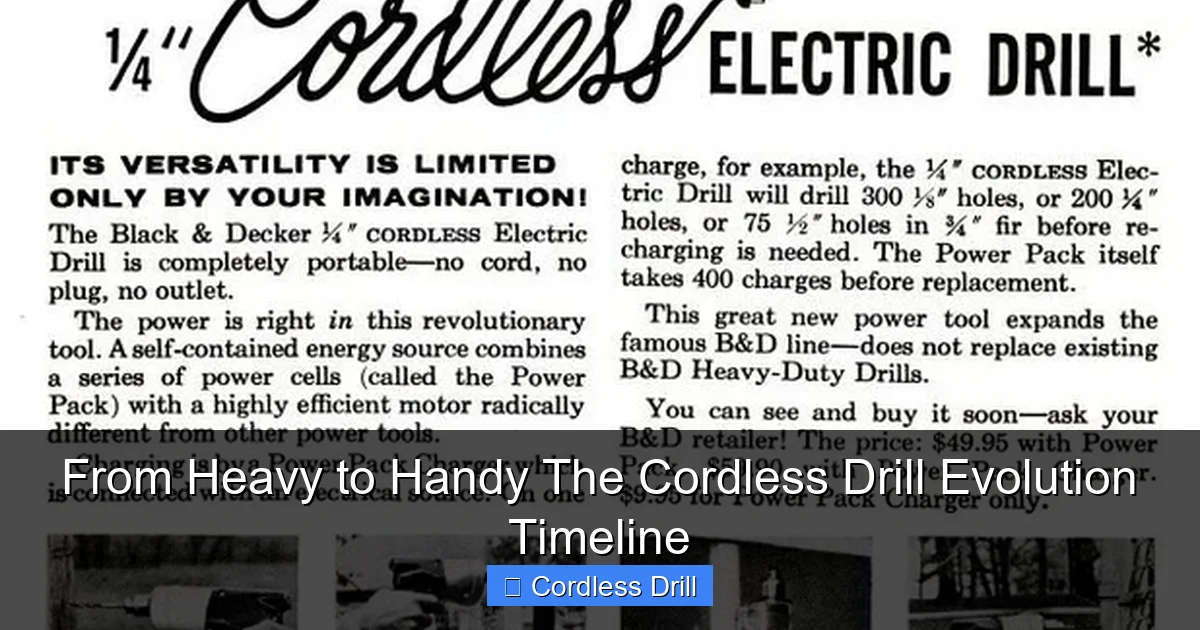
The story begins in 1961. Black & Decker, partnering with Martin Marietta Corporation for NASA, developed a zero-impact wrench. It was for the Gemini program. This work with battery-powered motors planted a seed. By the mid-1960s, Black & Decker released the first cordless drill for the consumer market.

Visual guide about From Heavy to Handy The Cordless Drill Evolution Timeline
Image source: ourhometools.com
The Technology of the Era
This pioneer was not the tool we know.
- Battery: It used a primitive Nickel-Cadmium (Ni-Cd) battery. Energy density was very low. This means it stored little power for its size and weight.
- Power & Runtime: It was incredibly weak by today’s standards, often below 100 in-lbs of torque. Runtime was measured in minutes, not hours. Recharging took a long time.
- Design: The drill was heavy, unbalanced, and expensive. It was more a proof-of-concept or a luxury novelty than a practical tool.
Practical Tip: If you ever find one of these in an old toolbox, it’s a collector’s item! But don’t expect to drive a deck screw with it.
The 1970s-80s: The Nickel-Cadmium Era (The Voltage Race Begins)
Cordless tools slowly entered workshops in the 70s and 80s. They were now marketed to professionals and serious DIYers. The key metric became voltage.
Visual guide about From Heavy to Handy The Cordless Drill Evolution Timeline
Image source: s3.amazonaws.com
Step-by-Step Advancements
1. The 7.2V Standard: This was the common starting point. Drills like the popular Makita 6010DW (released in 1978) ran on 7.2V Ni-Cd packs. They could drive small screws and drill softwood. But they stalled quickly on tough jobs.
2. Introduction of 9.6V and 12V: To offer more power, companies increased voltage. A 9.6V or 12V drill in the late 80s was considered professional-grade. It had more “oomph” for driving larger screws.
3. The Major Flaw: Memory Effect: Ni-Cd batteries had a critical weakness. If you didn’t fully drain them before recharging, they “remembered” the shorter capacity. This drastically reduced runtime over time. Proper battery maintenance was a chore.
This era established cordless tools as viable, but with big compromises. You traded unlimited power for limited portability. For a deeper look at modern options born from this era, check out our guide to the Best Cordless Drill choices today.
The 1990s: Refinement and The 14.4V/18V Power Surge
The 90s was the decade of muscle. The race for power hit high gear. The goal was to match the performance of corded drills.

Visual guide about From Heavy to Handy The Cordless Drill Evolution Timeline
Image source: toolsadvisers.com
Key Developments
1. 14.4V and 18V Platforms: Brands like DeWalt (with its iconic yellow tools), Milwaukee, and Makita pushed voltages higher. The 18V Ni-Cd drill became the flagship for contractors. It could handle mixing thin mortar, drilling large holes in studs, and sustained screw driving.
2. Improved Ni-Cd Cells: Battery technology improved slightly. New cell designs offered better energy density. This meant more runtime for the same bulky pack size.
3. The Weight Problem: An 18V Ni-Cd battery pack was a brick. A complete drill could weigh over 7 pounds. Using it overhead was a workout. The trade-off for power was severe user fatigue.
Example: A contractor in 1995 might have an 18V Ni-Cd drill for heavy work and a lighter 12V model for finish work. This two-drill system was common but expensive.
The Early 2000s: The Lithium-Ion Revolution (A Game Changer)
Everything changed with the commercial adoption of Lithium-ion (Li-ion) batteries. This wasn’t just a step forward. It was a quantum leap.
How Lithium-Ion Changed the Game
- Higher Energy Density: Li-ion packs stored 2-3 times more energy than a same-size Ni-Cd pack. Suddenly, an 18V battery could be half the size and weight.
- No Memory Effect: You could recharge a Li-ion battery at any time without harming it. Battery maintenance anxiety disappeared.
- Faster Charging: Many early Li-ion chargers cut charge times to 30 minutes or less.
- Steady Power Delivery: Unlike Ni-Cd, which faded as it drained, Li-ion delivered nearly full power until it was almost dead.
The first major player was DeWalt with its 36V system (using two 18V Li-ion packs) in 2005. Soon, 18V Li-ion became the new universal standard. Power and runtime were finally in balance. This era truly birthed the modern, capable Cordless Drill as we know it.
The 2010s: The Rise of Brushless Motors and Ecosystem Wars
With the battery problem solved, engineers turned to the motor. The old brushed motor was inefficient. It created friction, heat, and wore out over time.
The Brushless Motor Advantage
Brushless motors use electronic controls to spin the motor. They have big benefits.
- More Power and Torque: They convert more battery energy into rotational force.
- Longer Runtime: Greater efficiency means up to 50% more work per charge.
- Longer Tool Life: No physical brushes to wear out. The tool runs cooler and lasts longer.
- Compact Size: Motors can be made smaller, improving tool balance.
The Tool Ecosystem: Brands stopped selling just drills. They sold platforms. One 18V or 12V Li-ion battery could now run a drill, impact driver, circular saw, job site radio, and even a lawn mower. You were buying into a brand’s universe of tools. This locked in customer loyalty but offered incredible convenience.
This period also clarified tool specialization. People learned the Difference Between Impact Driver and Hammer Drill, allowing them to choose the perfect tool for drilling into masonry versus driving long screws.
The 2020s and Beyond: Smart Tools and Hyper-Efficiency
Today, the evolution focuses on connectivity, customization, and refinement.
Current State-of-the-Art Features
1. Advanced Electronics: Drills now have computer-like brains. They offer multiple speed/torque settings. They can sense when a screw is seated and stop automatically to prevent stripping.
2. Bluetooth and App Integration: You can customize torque settings, track your tool’s location, monitor battery health, and even lock the tool if stolen—all from a smartphone app.
3. Compact and Sub-Compact Designs: New battery cell formats (like 21700 cells) pack more power into smaller packs. 18V drills are now as small and light as 12V drills from a decade ago.
4. Focus on Ergonomics: It’s not just about raw power. It’s about reducing fatigue. Better grips, optimized balance, and lower noise/vibration are key selling points.
For instance, understanding the Difference Between a Drill and a Hammer Drill is crucial for selecting a modern tool that can handle everything from simple assembly to light masonry.
Troubleshooting the Evolutionary Journey
Even with today’s advanced tools, knowing their history helps solve problems.
- Problem: Old Ni-Cd drill won’t hold a charge. Solution: This is the “memory effect.” The battery is likely dead. It’s more cost-effective to upgrade to a modern Li-ion tool.
- Problem: New drill has less torque than expected. Solution: Check the gear setting. Many modern drills have a 2-speed gearbox. Low speed (1) is for high torque (driving screws). High speed (2) is for fast drilling.
- Problem: Choosing between many similar models. Solution: Consider the ecosystem. If you already own a brand’s battery, stick with it. Think about your future needs—will you want a cordless saw or light that uses the same battery?
Conclusion: The Future is Cordless
The cordless drill’s journey is a story of liberation. It moved from a weak, heavy curiosity to the indispensable, powerful heart of the modern tool kit. Each era solved a critical problem: first portability, then power, then efficiency, and now intelligence.
The next time you pick up your cordless drill to hang a picture or build a fence, remember its history. You’re holding over 60 years of innovation. From the clunky Ni-Cd bricks of the past to the sleek, smart tools of today, the evolution is a testament to human ingenuity. The goal was always the same: to make the job easier. And that mission, much like your drill, is fully charged and ready for the next task. Whether you’re a DIY novice learning How To Use A Drill For Screws Into A Wall or a pro on a job site, you’re benefiting from this remarkable timeline.
