This guide uncovers the fascinating hammer drill invention history, tracing its journey from early manual tools to the modern powerhouse. You’ll learn about the first patented rotary hammer in 1914 by German engineers, the pivotal transition to cordless technology, and how this tool solved the age-old problem of drilling into hard materials like concrete. Understanding this history reveals why the hammer drill is an indispensable tool today.
Have you ever looked at a concrete wall and wondered, “How do I put a hole in that?” For centuries, that was a major headache. The answer, the hammer drill, is a marvel of engineering we often take for granted. But its story is one of brilliant innovation. This guide will walk you through the complete hammer drill invention history. We’ll travel from ancient chisels to the first electric sparks in Germany. You’ll see how this tool evolved. You’ll understand the key inventors and breakthroughs. By the end, you’ll not only know its past but also appreciate the sophisticated tool in your hands today. Let’s start drilling into history.
Key Takeaways
- The First Patent Was German (1914): The core mechanism of the modern hammer drill was first patented by the German company Bosch, based on the work of engineers like Fein and Wacker.
- It Solved a Masonry Problem: The invention was driven by the need to efficiently drill into concrete, stone, and brick, moving beyond slow and laborious hand tools.
- Pneumatic Power Paved the Way: Before widespread electric models, pneumatic (air-powered) hammer drills were crucial on large construction sites and mining operations.
- Cordless Revolutionized Portability: The advent of powerful battery technology, notably Lithium-ion, freed the hammer drill from the wall outlet, transforming job site flexibility.
- Two Main Types Emerged: The history led to two primary designs: the compact “hammer drill” (comb-drill) for DIYers and the more powerful “rotary hammer” (SDS) for professionals.
- Technology is Still Evolving: Modern advancements include brushless motors, smart electronics, and improved vibration control, making tools more efficient and user-friendly.
- Its Impact is Everywhere: From skyscrapers to home renovations, the hammer drill’s invention directly enabled faster, safer, and more complex construction projects.
Step 1: Understanding the “Why” – The Problem Before the Invention
Before the hammer drill, working with hard materials was slow, hard work. Imagine needing to run electrical wire through a concrete foundation using just a club hammer and a star chisel. You’d hit, rotate, hit, rotate—for hours. This “hammer and chisel” method was the only way. Masons and builders needed a faster, less exhausting solution. The core problem was combining a hammering force with a rotating drill bit. Solving this would change construction forever.
The Manual Predecessors
Craftsmen used tools like the star drill, a shaped steel rod. They would hit it with a sledge hammer and give it a partial turn between blows. It worked, but progress was measured in inches per hour. The physical toll was immense. This created a clear market need for a mechanized solution.
Step 2: The First Breakthrough – The Pneumatic Era (Late 1800s)
The first step away from manual labor was air power. In the mid-to-late 1800s, pneumatic tools emerged. These used compressed air to create a rapid hammering action.

Visual guide about Uncovering the Hammer Drill Invention History
Image source: lolaapp.com
How Early Pneumatic Hammers Worked
An air compressor would send power through a hose to a tool. Inside, a piston would cycle back and forth at high speed, smashing against a chisel or drill steel. These were essentially powerful, mechanized hammers. They were huge, loud, and tied to a bulky air compressor. They revolutionized mining and rock breaking but were not yet the rotary hammer drill we know. They provided the hammering action but lacked the precise rotation needed for clean drilling.
Step 3: The Pivotal Invention – The First Electric Hammer Drill (1914)
This is the moment. The key patent for the electro-pneumatic hammer drill mechanism was filed in 1914. It is widely credited to the German company Bosch, based on the work of engineers.
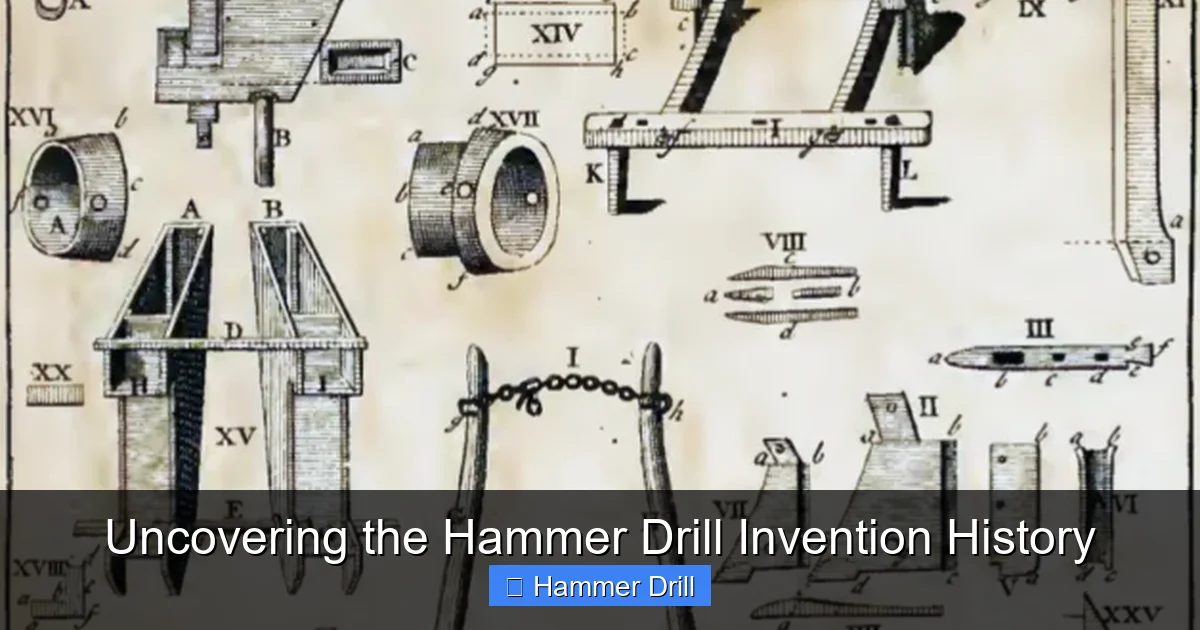
Visual guide about Uncovering the Hammer Drill Invention History
Image source: historydefined.net
The Key Innovators: Fein, Wacker, and Bosch
While several minds were working on the problem, the breakthrough is tied to German engineering. The mechanism used an electric motor to drive a crank. This crank moved a piston back and forth in a cylinder. The action of the piston created air pressure that, in turn, amplified the hammering force on the drill bit—all while the motor also turned the bit. This “electro-pneumatic” system was genius. It was more efficient and compact than pure pneumatic tools. Bosch commercialized this technology, putting the first recognizable hammer drills into the hands of tradespeople.
Why Germany?
Post-industrial Europe, and Germany in particular, was a hub for precision manufacturing and electrical innovation. The demand for rebuilding infrastructure and advancing construction techniques made it the perfect incubator for such a tool.
Step 4: Evolution and Specialization (Mid-20th Century)
After the initial invention, the 20th century was about refinement and specialization. The core patent opened the floodgates.

Visual guide about Uncovering the Hammer Drill Invention History
Image source: the-word-online.com
The Birth of the “Rotary Hammer” (SDS System)
A major leap came with the development of the dedicated “rotary hammer.” Unlike a standard drill with a hammer function, a rotary hammer has a more robust mechanism. Its biggest innovation was the SDS (Slotted Drive System) chuck, invented by Bosch in 1975. This allowed bits to slide back and forth in the chuck, transferring hammer energy more directly and making bit changes tool-free. This design is why professionals reach for an SDS rotary hammer for serious masonry work, while a standard hammer drill suffices for lighter duty.
The Rise of the Consumer “Hammer Drill”
For the average homeowner, the full power of a rotary hammer was overkill. Tool makers created the “hammer drill” or “comb-drill.” This is a standard power drill with an extra mode. In this mode, two ribbed metal discs clash together as the drill spins, creating a vibrating hammering action. It’s less powerful than an electro-pneumatic system but perfect for the occasional hole in brick or block. Understanding the difference between an impact driver and a hammer drill also became important as toolkits expanded.
Step 5: The Cordless Revolution (Late 20th Century – Present)
The next giant leap was cutting the cord. Early cordless drills of the 1970s and 80s were weak. Their Nickel-Cadmium batteries couldn’t deliver the sustained power needed for hammering.
The Battery Breakthrough
The shift to Nickel-Metal Hydride (NiMH) and, crucially, Lithium-ion (Li-ion) batteries changed everything. Li-ion batteries offered higher voltage, more energy density, no memory effect, and less weight. Suddenly, a cordless hammer drill or even a compact cordless rotary hammer could rival the power of some corded models. This transformed job sites, allowing work anywhere without a generator or long extension cords.
The Modern Cordless Ecosystem
Today, we live in the age of the cordless platform. You can get a top-rated best cordless drill that includes a hammer function, all sharing batteries with dozens of other tools. This convenience and power are direct results of this historical evolution in battery tech.
Step 6: Modern Refinements and Smart Technology
The invention story isn’t over. Today’s hammer drills are smarter, tougher, and easier to use.
- Brushless Motors: More efficient, longer-lasting, and more powerful than traditional brushed motors.
- Advanced Vibration Control: Reducing user fatigue and the risk of long-term injury (like HAVS).
- Electronic Controls: Precision variable speed triggers, impact rate controls, and automatic shut-offs.
- Multi-Functionality: Many drills now offer “drill,” “hammer drill,” and “drive” modes in one compact body, making them incredibly versatile for projects like drilling and driving screws into walls.
Troubleshooting the Historical Perspective
Issue: “I’m confused about all the different types—hammer drill, rotary hammer, impact driver.”
Historical Solution: This confusion is a product of their evolution. Remember: The rotary hammer (SDS) is the direct, powerful descendant of the 1914 invention for heavy masonry. The hammer drill is a lighter, consumer-grade combo tool. The impact driver is a different tool entirely for driving screws and bolts, using a rotational impact mechanism, not a hammering one.
Issue: “Why does my modern hammer drill seem so much better than my old one?”
Historical Solution: You’re seeing over a century of incremental improvements! Better motor materials, precision engineering, lithium-ion batteries, and ergonomic design have all compounded. The core electro-pneumatic idea is the same, but its execution has been perfected.
Conclusion: The Impact of a Simple Idea
The hammer drill invention history is a powerful tale of human ingenuity. It started with a simple need: to break rock faster. It moved through air power, found its electric heart in a German workshop in 1914, specialized into powerful and consumer tools, and finally broke free with battery technology. Each step was built on the last. Today, this tool is fundamental to building our world. From the tallest skyscraper to a simple shelf in your garage, the hammer drill made it possible. The next time you press the trigger and hear that familiar “tap-tap-tap-brrrr,” remember you’re holding over 100 years of mechanical evolution in your hands.
🎥 Related Video: Magnet Claw Hammer, High Performance Hardware Tools Good Tools For Best Recommendations #shortsfeed
📺 Hardware Tools
Hardware tools encompass a wide range of equipment used for various tasks such as construction, repair, maintenance, and …